


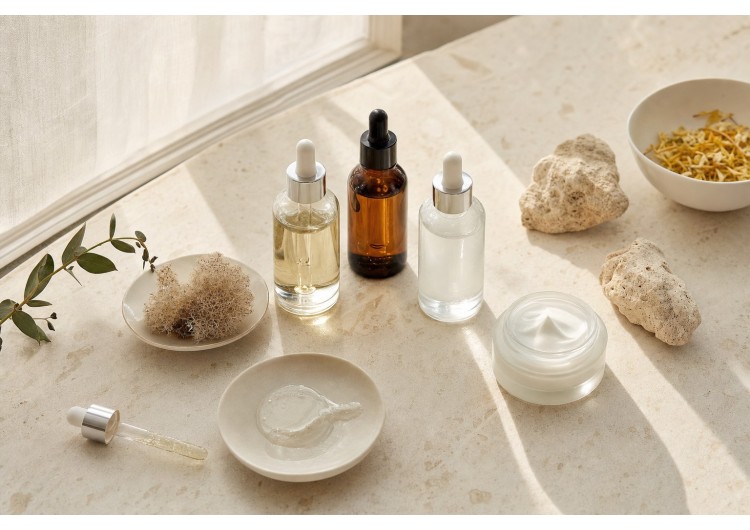
An INCI list often looks more complicated than it really is. Once you can recognise ingredient order and a few major groups — humectants, emollients, occlusives, active ingredients, preservatives and fragrance — the structure of a product becomes easier to understand. This guide provides a practical way to read a formula without judging it by one ingredient or trying to guess concentrations that the label may not disclose. The aim is to connect composition with texture, intended use, the needs of your skin and your own tolerance.
Why learn to read a cosmetic formula?
An ingredient list provides useful information, but it does not tell the product’s entire story. It can help you identify major ingredient groups, anticipate texture, spot something you prefer to avoid and compare similar products. It rarely reveals exact percentages, raw-material quality or every detail of the manufacturing process.
Reading a formula is therefore not about dividing ingredients into « good » and « bad » categories. An ingredient may be helpful in one cream and less suitable in another context. Its effect depends on the amount used, the surrounding formula, the product format, storage conditions and individual tolerance.
Understanding the basic INCI rules
Ingredients generally appear in descending order
INCI stands for International Nomenclature of Cosmetic Ingredients. Ingredients are generally listed from the highest to the lowest amount. The first entries often make up the product base: water, oils, solvents or cleansing agents. Around the 1% level, the order may become more flexible under applicable labelling rules, while colourants are often listed near the end.
This rule reveals the broad structure, but it cannot provide an exact concentration. An active ingredient in the middle or near the end is not necessarily insignificant, as some substances are used at low levels. Likewise, featuring a well-known ingredient in the product name does not mean that it dominates the formula.
Technical and botanical names
Water appears as Aqua, glycerine as Glycerin and shea butter as Butyrospermum Parkii Butter. Plant extracts commonly use Latin botanical names, sometimes followed by the plant part and extraction type. You do not need to memorise every term. Recognising functional groups is already a reliable starting point.
Humectants, emollients and occlusives
Humectants help hold water
Humectants support water retention in the skin’s outer layers. Common examples include Glycerin, Propanediol, Butylene Glycol, Betaine, Sodium PCA, Urea, Panthenol and forms of hyaluronic acid such as Sodium Hyaluronate or Hydrolyzed Hyaluronic Acid.
A humectant-rich formula can feel fresh and flexible, which is common in serums and gels. Hydration does not rely on one ingredient, however. Skin that loses water easily may also benefit from emollients and occlusives that complement a humectant formula.
Emollients soften the surface
Emollients temporarily smooth the spaces between cells in the outer skin layer and improve slip. They include plant oils, esters such as Caprylic/Capric Triglyceride, fatty alcohols such as Cetearyl Alcohol, ceramides, squalane and certain silicones.
The word « alcohol » needs context. Cetearyl Alcohol and Cetyl Alcohol are fatty alcohols used for texture and comfort; they do not behave like the more volatile Alcohol or Alcohol Denat. The latter may lighten a texture or help it dry quickly and are not automatically unsuitable for everyone. Concentration, frequency and skin sensitivity matter.
Occlusives reduce evaporation
Ingredients such as Petrolatum, some butters, waxes, Dimethicone and Lanolin form a surface film to varying degrees. They are useful in balms, dry-area treatments and protective formulas. An occlusive texture is not necessarily heavy or pore-clogging for every person. The complete formula and individual skin behaviour remain important.
How should active ingredients be interpreted?
An active does not need to top the list
Niacinamide, exfoliating acids, cosmetic retinoids, vitamin C and its derivatives, peptides, ceramides and antioxidant extracts are commonly described as active ingredients. Their position offers only an imperfect clue. Some are formulated at several percentage points, while others are used at much lower levels. Unless a percentage is disclosed, avoid calculating concentration from INCI position alone.
The chemical form also matters. Ascorbic Acid does not have the same properties as Ascorbyl Glucoside. Retinol, Retinal and retinol esters are not interchangeable. Stability, pH, packaging and the surrounding formula can all influence the user experience.
More actives do not always make a better routine
A long list of fashionable actives may look appealing, but routine consistency matters more. Introducing several exfoliants, retinoids or heavily fragranced products at the same time can make it difficult to identify the cause of discomfort. Gradual introduction makes it easier to monitor dryness, comfort and tolerance without expecting unrealistic results.
Fragrance and listed fragrance allergens
Parfum, Aroma and individual fragrance compounds
Parfum or Fragrance refers to a scented blend whose complete composition is not necessarily shown. Some products use the term Aroma. Regulated fragrance compounds such as Limonene, Linalool, Citral, Geraniol or Coumarin may also be listed individually, depending on their presence and the labelling thresholds of the relevant market.
Their presence does not mean that a product will automatically cause discomfort. The information is especially helpful for people with a known sensitivity or those who prefer to limit fragrance. Essential oils also contain aromatic compounds, so « natural » does not mean fragrance-free or universally well tolerated.
Choose according to your own tolerance
Reactive skin, a sensitive eye area or a routine already rich in active ingredients may make a fragrance-free product preferable. Other people enjoy scented skincare without discomfort. If unsure, test a small amount on a limited area and space out the first applications. A significant or persistent reaction calls for advice from a healthcare professional.
A five-step reading method
- Identify the product type: a rinse-off cleanser, a serum and a balm have different structures and contact times.
- Review the first five to ten ingredients: they suggest whether the base is watery, oily, silicone-rich, alcohol-based or cleansing.
- Find the main groups: humectants, emollients, occlusives, surfactants, active ingredients, preservatives and fragrance materials.
- Apply your personal criteria: known allergens, fragrance, preferred texture, actives already in your routine and ingredients you have not tolerated before.
- Consider real-life use: amount, frequency, season and combination with other products matter as much as the label.
Three quick reading examples
A water-based serum
If Aqua, Glycerin and Propanediol lead the list, followed by a gelling agent and Sodium Hyaluronate, the product is likely to have a light, mainly humectant texture. Dry skin may feel more comfortable when the serum is followed by an emollient cream.
A nourishing cream
A base combining water, Caprylic/Capric Triglyceride, squalane, fatty alcohols, glycerine and a plant butter suggests an emulsion containing both water-binding and lipid ingredients. An active or fragrance near the end should be interpreted according to its function, not dismissed automatically.
A cleanser
In a rinse-off product, focus on surfactants such as Coco-Betaine, Sodium Cocoyl Isethionate or Decyl Glucoside, along with comfort-enhancing ingredients. Mildness cannot be predicted from one surfactant alone: the blend, pH and washing frequency also affect how the cleanser feels.
Key takeaways
- The first ingredients describe the product base, but an INCI list does not always disclose exact concentrations.
- Humectants, emollients and occlusives have different, often complementary roles in skincare.
- INCI position alone cannot determine the value of an active; its form, level, stability and overall formula also matter.
- The most suitable choice depends on use, routine and personal tolerance rather than a universal ingredient ranking.
Related products
- Martiderm Expression Soin Contour Des Yeux et Lèvres 15ml
- Lancaster Golden Tan Maximizer After Sun Serum 30ml
- Institut Esthederm Photo Regul Soin Protecteur Unificateur Soleil Fort 50ml
- Avène Hyaluron Activ B3 Soin Yeux Triple Correction 15 ml
- Anne Möller Stimulâge Sérum Intensivo Recuperador De Juventud 30ml
- Juvena Fascianista Body Serum 125ml