


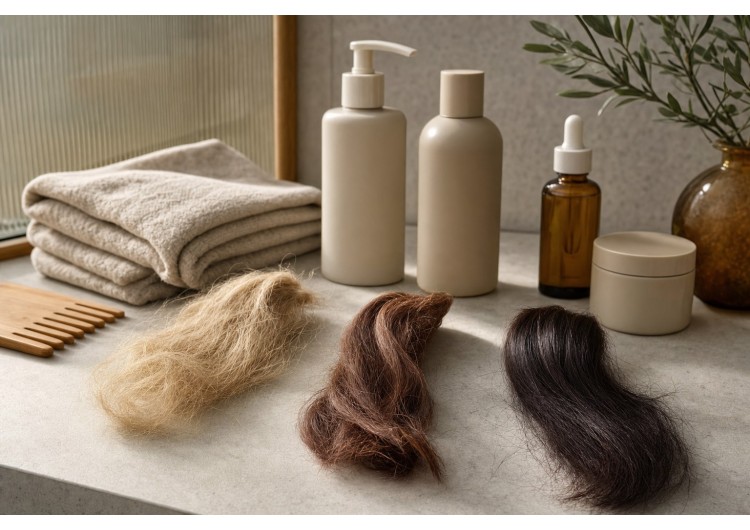
Dull, rough or difficult-to-manage hair does not always need the same treatment. Dryness is mainly associated with reduced suppleness and a lack of protective lipids, while colour-treated hair requires measures that limit fading. Weakened hair, meanwhile, has lost some of its resistance to brushing, heat or tension. These conditions can also overlap. Before selecting a shampoo, mask or leave-in product, it helps to observe the fibre, ends, scalp and everyday habits. This guide explains the main signs and shows how to create a balanced routine without layering more products than necessary.
Choosing hair care solely because a label says “dry” or “damaged” can lead to an unbalanced routine. Two heads of hair that feel rough may have different needs: one may lack protective lipids, another may have been weakened by repeated bleaching, while a third may simply carry too much product residue. The aim is not to make a definitive diagnosis, but to look for several consistent signs and adjust product texture, frequency and placement accordingly.
Dry, colour-treated and weakened hair are not the same
Dry hair needs suppleness and protection
Sebum produced by the scalp helps lubricate the hair fibre. When it does not travel easily along the lengths — as can happen with curly, coily, very long or frequently washed hair — the cuticle is left more exposed. The lengths may look dull, tangle easily, react strongly to humidity and feel rough. It is also possible to have dry ends and an oily scalp, which means the two areas should be treated separately.
Humectants, fatty alcohols, oils, butters and conditioning agents can support softness and help slow moisture loss. A very rich formula is not always required, however. Fine hair may respond better to a light emulsion or a small amount of serum applied only to the ends.
Colour-treated hair needs help maintaining its appearance
Colour services affect the fibre to varying degrees. Temporary colour sits mainly on the surface, whereas permanent colour and bleaching involve more substantial changes to the cuticle. The priority is to reduce pigment loss and limit factors that make colour look dull: very frequent washing, hot water, uncontrolled heat styling and prolonged sun exposure.
A gentle shampoo, regular conditioner and heat protectant are often more useful than layers of masks. Pigmented products can refresh a shade or neutralise unwanted tones, but they should be spaced out and monitored. Overuse can create an uneven, overly cool or darker result, especially on porous areas.
Weakened hair has lost some mechanical resistance
Common signs include breakage, split ends, many short pieces of different lengths or unusual stretchiness when the hair is wet. Bleaching, chemical straightening, repeated heat, tight hairstyles and friction can all contribute. Breakage along the shaft should not be confused with shedding from the root.
Hydrolysed proteins, amino acids, ceramides and film-forming ingredients can temporarily improve feel and mechanical resistance. They cannot permanently seal a split end. When the tips are severely weathered, a targeted trim remains the clearest way to restore a more even edge.
What to observe before changing your routine
Look at your hair over several wash days rather than drawing conclusions from one morning. Start by separating scalp needs from length and end needs, then observe the fibre both wet and dry.
- Feel: rough yet resilient hair may mainly need conditioning, while a very soft, overly stretchy and fragile fibre may show more significant weakening.
- Appearance: dullness can result from dryness, hard-water minerals, product build-up or an uneven cuticle.
- Detangling: frequent knots suggest greater friction between fibres. A well-formulated conditioner can help reduce pulling.
- After washing: roots that become heavy quickly alongside dry ends call for targeted product placement rather than rich care all over.
Porosity is a clue, not a complete diagnosis
Porosity describes how easily the fibre takes in and loses water. Highly porous hair may become wet quickly, frizz readily and absorb generous amounts of product without staying supple for long. Bleaching and repeated high heat can increase porosity. Low-porosity hair may take longer to become fully wet and can be weighed down by heavy butters or oils.
The popular glass-of-water strand test is unreliable because sebum, residue and surface tension influence the result. Observing the whole head after washing is more informative: consider drying time, frizz, the amount of product required and how long softness lasts.
Give each product category a clear role
Shampoo primarily cleans the scalp
A gentle shampoo is suitable for many routine washes, particularly for dry or colour-treated hair. There is usually no need to rub the ends vigorously; the lather that runs through them while rinsing is often sufficient. If dry shampoo, oils, silicones or mineral deposits have built up, an occasional clarifying wash may restore lightness. Clarifying should respond to a visible need rather than become an automatic step.
Conditioner supports detangling
Applied through the mid-lengths and ends, conditioner reduces friction and makes combing easier. For many people with dry or colour-treated hair, it is the most consistently useful step. Detangle with your fingers or a wide-tooth comb, beginning at the ends and working upwards without pulling.
A mask provides more concentrated conditioning
A nourishing mask containing oils or fatty alcohols may suit thick, dry lengths. A strengthening formula with proteins or amino acids can be useful after chemical processing. Used too frequently, however, some protein-rich products may leave certain hair types feeling stiff. Alternating nourishing and strengthening care according to the hair’s response allows for better balance.
Leave-in care protects between washes
A lightweight cream can help maintain suppleness, while a serum or a few drops of oil can reduce friction and make the ends look smoother. Apply these products sparingly, mainly to the lower lengths. Oil does not add water to the hair; it mainly forms a film that helps reduce loss and improves surface feel.
Build a simple routine that can be adjusted
A practical foundation includes a shampoo suited to the scalp, a conditioner for the lengths and a heat protectant whenever hot tools are used. Add a mask once a week or every other week, depending on how the hair responds. If hair is simultaneously colour-treated, dry and weakened, divide these needs across a few well-chosen steps instead of expecting one product to do everything.
- Wash with lukewarm water and rinse thoroughly to prevent residue.
- Blot out excess water with a soft towel rather than rubbing the lengths.
- Use a moderate dryer setting and keep the airflow moving.
- Avoid repeatedly passing straighteners over the same section.
- Reduce overnight friction with a loose style that does not pull at the roots.
Recognise when a routine is too rich or not conditioning enough
Hair that feels flat, coated, sticky or difficult to rinse may be receiving too many heavy products. Reduce the quantities, space out oil applications and clarify occasionally if there is clear build-up. If the lengths remain rough, static-prone and tangled despite gentle cleansing, increase conditioning gradually with a more substantial conditioner, a carefully dosed mask or a light leave-in product.
Change one element at a time and monitor the result over two or three washes. This makes it easier to identify what is genuinely useful. Sudden shedding, persistent itching, patches or scalp lesions warrant advice from a doctor or dermatologist rather than the addition of more cosmetic products.
Key takeaways
- Separate the needs: dryness mainly affects suppleness, colour treatment calls for fade protection, and weakening is most clearly associated with breakage.
- Observe before buying: feel, tangling, root behaviour, apparent porosity and post-wash results are more informative than a single label.
- Give every step a purpose: shampoo cleans, conditioner detangles, a mask supplements care and leave-in products protect the lengths.
- Adjust gradually: a small amount placed where it is needed is often more useful than layering several rich formulas.
Related products
- Jeanne Piaubert Radical Firmness Masque Lifting 75ml
- Beauterra Shampooing Soin Champú Anticaspa 750ml
- Klorane Shampooing Nourrissant Au Monoï Et Tamanu Bio 200ml
- La Roche Posay Kerium Doux Extreme Shampooing 400ml
- Botánicapharma Shampooing à la Biotine et à la Prêle 250ml
- Avène Cleanance 3 en 1 Masque Détox 50ml